A property titan in crisis: What went wrong at China’s Evergrande and what's next
SINGAPORE: Information technology narrowly averted a cash crunch last year but Evergrande, one of China'south biggest existent manor developers, is now teetering on the brink of bankruptcy once more.
The greenbacks-strapped property titan has warned that information technology may not be able to meet its staggering debts of more US$300 billion – an amount that makes it the world's virtually indebted real estate visitor.
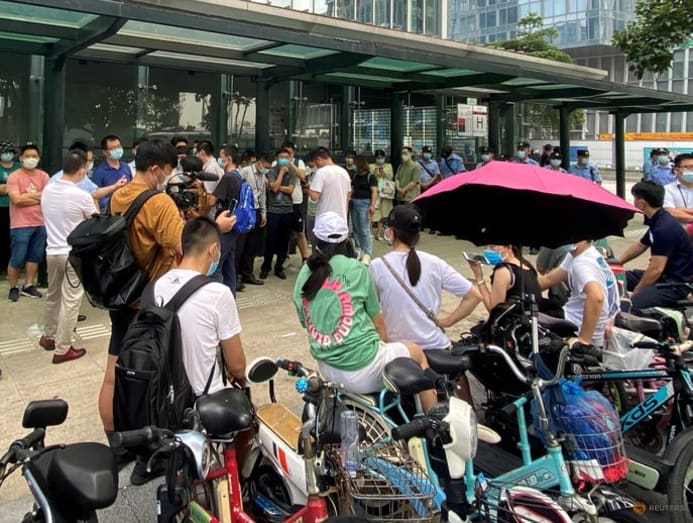
This has stirred panic amongst many contractors and suppliers, bail-holders also every bit dwelling house buyers who have made down payments for now-stalled holding projects, as seen from the protests exterior Evergrande'due south headquarters in Shenzhen this calendar week.
There are likewise fears that the demise of ane of China'south biggest companies could send ripples across the globe'south 2nd-biggest economy.
Here's what we know so far:
WHO IS EVERGRANDE?
Founded in 1996 by Hui Ka Yan, Evergrande started off as a small local business firm in Guangzhou before riding on Prc's real estate boom to go the state's second-biggest programmer by sales.
It went public in 2009 in Hong Kong, a movement that it described equally "providing stiff impetus" to its growth.
Evergrande currently owns more than 1,300 projects, more often than not residential, in more than 280 Chinese cities, according to the company's website.
Outside of belongings development, an all-out diversification in recent years has seen the company extending its achieve into media production, healthcare services, mineral water and nutrient, electric car manufacturing, as well equally the running of a theme park and football club.
In all, it has 200,000 staff and total avails worth two.3 trillion yuan, its website said.
WHAT WENT WRONG?
Evergrande has fuelled its expansion primarily through ambitious leverage since the beginning, so much and so that its founder Hui is too described as China's "rex of debt" while being known as a property mogul and at i point Red china'south richest.
This credit-fuelled business concern strategy has been on shaky grounds, especially after the Chinese regime appear its "three red lines" policy last August. This is a trio of metrics on debt that developers accept to meet if they want to borrow more.
A new "era of sustained decline" in residential property demand in Prc is another crusade of trouble for highly leveraged developers like Evergrande, said research firm Majuscule Economic science in a annotation dated Sep 15.
The visitor had a liquidity scare in September terminal twelvemonth when it reportedly sent a letter to the provincial regime of Guangdong, alarm officials that payments due in January 2022 could crusade a liquidity crisis and potentially lead to cross defaults in the broader financial sector.
It managed to avert the crisis after persuading a group of investors to waive their right to forcefulness a Usa$thirteen billion repayment, said a Bloomberg report.
That same month, Evergrande too kicked off a nationwide sales promotion, offering a 30 per cent disbelieve on all real estate properties, in a bid to heave sales and meet its target of cutting debt by half.
Amid other moves to shore upwards its finances, it listed its property direction unit in a US$i.eight billion initial public offer (IPO) in Hong Kong terminal December.
It also sold a US$iii.four billion stake in its electrical vehicle unit of measurement, while unveiling plans to spin off several units such as its online real estate and auto marketplace Fangchebao.
These proved to be futile as Evergrande said on Tuesday that its asset and equity disposal plans to ease liquidity issues "have not reached expected outcomes".
In the same statement to the Hong Kong Stock Commutation, it too said property sales will likely keep to turn down significantly in September, on the back of "ongoing negative media reports" that have dampened the confidence of potential buyers. This will add "tremendous" force per unit area to its cash menses state of affairs, it warned.
The company added that it has engaged directorate to examine its financial options and warned of a default risk.
Evergrande'southward stock has since fallen off a cliff amid the continuous flow of bad news, down more than 30 per cent this week. It was last seen trading at HK$2.37 on Friday morn, the lowest in more than than a decade.
Meanwhile, ratings agencies have repeatedly downgraded the business firm, citing its liquidity problems.
Scenes of protests have also emerged, according to media reports, as angry investors, vendors who are owed money, also as dwelling buyers, gathered this week at the company'southward headquarters in Shenzhen to demand repayment.
IS THERE A BROADER Chance?
Analysts take been monitoring the possibility of a wider touch on Prc's property sector.
Ms Zhou Chuanyi, a credit annotator at Lucror Analytics, said the contagion risk on Chinese property issuers "has been pregnant" then far.
"The bonds of many weak names have been hit. At current price levels, it is unlikely that a number of those developers will be able to upshot new offshore bonds. This brings some refinancing uncertainties," she told CNA in an emailed response.
Beyond property, a collapse of Evergrande could trigger a broader hit on the country'due south financial system and the overall economy, analysts said.
"We believe a default would reinforce credit polarisation amongst homebuilders and could event in headwinds for some smaller banks," said rating bureau Fitch.
Capital Economics noted that the banking sector would be among the first to exist striking, adding that the plummet of Evergrande would be "the biggest test that People's republic of china's financial system has faced in years".
"A banking failure triggered past the collapse of major belongings developers was the single nearly probable scenario that could lead to a difficult landing in Cathay. And the fact that financial markets aren't currently signalling alarm doesn't mean they won't," wrote its chief Asia economist Mark Williams in a note final week.
Mr Howe Chung Wan, managing managing director and head of Asia fixed income for Principal Global Investors, said: "Transmission of a holding downcycle will more often than not come through lower property investments, impact on consumption due to weaker household sentiment and employment market, as well as more negative market sentiments."
WHAT COULD HAPPEN Adjacent?
The company is most likely headed towards a debt restructuring, analysts said, with the key now being how orderly the debt woes will exist managed.
Mr Vishnu Varathan, head of economics and strategy at Mizuho Bank, said policy responses then far suggest that authorities may want to "make an instance out of Evergrande so that there's no such thing equally too big to fail".
"This is non going to be a instance of a white knight riding to the rescue in the very short term but clearly, the social attribute is going to be something very sensitive. I think the government will eventually footstep in just for very targeted reasons," he told CNA.
These include ensuring Evergrande delivers the yethoped-for-completed properties to millions of home owners.
"Policymakers' main priority would be the households that have handed over deposits for properties that haven't notwithstanding been finished," said Mr Williams.
Capital Economic science said pre-completion deposits from households business relationship for the majority of Evergrande's liabilities. Information technology estimates that the company has about one.three trillion yuan in pre-sale liabilities every bit at end-June, equivalent to roughly 1.iv million individual properties that it has committed to consummate.
Mr Howe noted that the "priority at present would be to go for an orderly restructuring and manage claims in an organised manner".
This is so that the company can restart operations and complete the building of unfinished homes to alleviate home buyers' demands, while generating greenbacks to pay out onshore retail claims over institutional claims, he added.
"Given the priority from (a) policy indicate of view would be to keep Evergrande delivering on its properties from a social stability perspective, a disorderly liquidation is not our base case scenario," said Mr Howe.
Ms Zhou also reckoned that liquidation is less probable to happen, given the size of Evergrande and the sheer amount of stakeholders involved.
"Beijing has never underestimated the systematic importance of Evergrande. It seems the government has been urging the company to put the interest of dwelling house buyers, suppliers and employees as its priorities," she said.
The possibility of introducing state-owned enterprise investors to Evergrande cannot be ruled out, said Ms Zhou, although regulators are unlikely to opt for a direct bailout.
A restructuring that prioritises home buyers might non leave much for other creditors, with offshore investors likely to be the biggest victims, analysts said.
Volition THERE Be REPERCUSSIONS Beyond People's republic of china?
Even so, a managed default or messy plummet of Evergrande would take "niggling global affect beyond some market turbulence", said Capital Economics' senior global economist Simon MacAdam.
"Fifty-fifty if it were the first of many property developers to go bust in Red china, we suspect it would accept a policy misstep for this to cause a sharp slowdown in its economy," he added in a Sep 16 note.
"In a difficult-landing scenario, several emerging markets are vulnerable. But in general, the global impact of swings in Chinese demand is often overstated."
Mr MacAdam added that references to Evergrande being China's "Lehman Brothers" – the collapse of the 150-year-old US investment bank in 2008 which precipitated the global fiscal crisis – "is wide off the mark".
Professor Lawrence Loh from the National University of Singapore Business concern School agreed, noting that the Lehman Brothers' downfall struck correct "at the heart of the financial industry".
In this example, while some pain must be expected from the woes of a huge conglomerate like Evergrande, the bear upon "may exist less and volition be indirect".
On the aforementioned note, spillover furnishings into the rest of the Asian economies are similarly not too much of a concern yet, analysts told CNA.
That said, businesses with exposure to Mainland china'due south property market place may be in for some challenges if this crisis somewhen takes a price on consumer confidence. This also comes as China'south economy took a hard knock lately due to the Delta virus outbreak, said Prof Loh.
Mr Varathan said foreign property businesses in Communist china "must presume some take chances".
"As they don't know how pressure on some of these contractors would translate for them, and whether they will be at the receiving end for some of this grief felt along the supply chain."
Source: https://cnalifestyle.channelnewsasia.com/business/china-evergrande-what-went-wrong-what-happens-next-294456
0 Response to "A property titan in crisis: What went wrong at China’s Evergrande and what's next"
Postar um comentário